

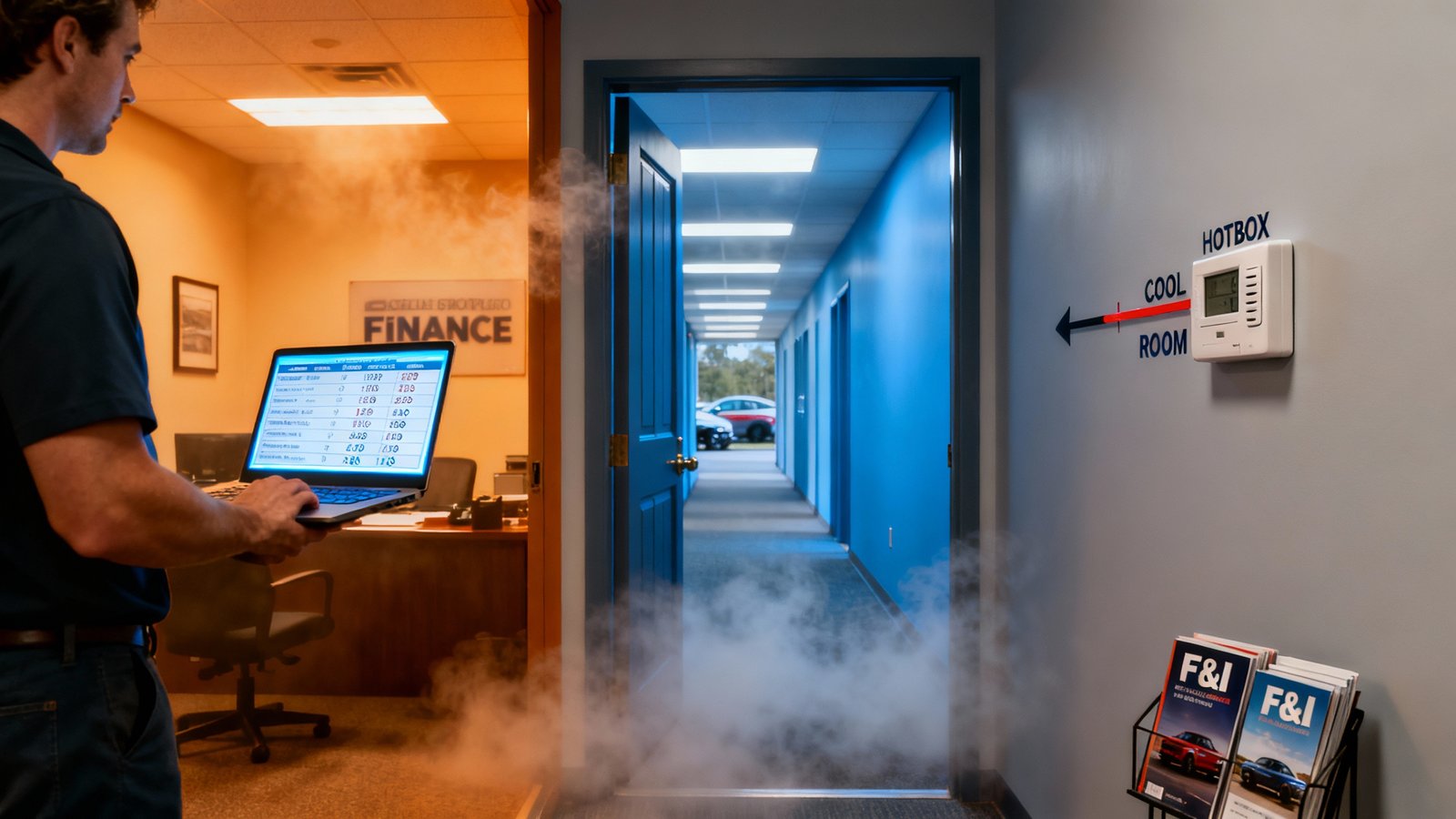
Escape the Hotbox
How to Keep Your Cool in the Car Finance Pressure Cooker
AUTOMOTIVE FINANCE • 2024
Welcome to the Hotbox
The first thing you notice in the finance office is not the paperwork. It’s the temperature. The door closes with a soft thud, the smile is turned up to broil, and suddenly you’re sweating over signatures you haven’t seen since your high school yearbook. Welcome to the Hotbox: a small, windowless room where paperwork multiplies faster than rabbits and the pen feels heavier than the car you’re buying.
“Hotbox” is the affectionate industry nickname for the finance and insurance (F&I) room—where the deal you negotiated outside meets the extras you didn’t. Extended warranties, GAP insurance, wheel protection, theft etching, fabric sealants that apparently repel time itself—the menu is long, the margins are larger, and the pitch is positioned as protection rather than product.
“The Hotbox is a real challenge for consumers. It’s a high-pressure sales environment designed to maximize dealer profits, not necessarily to serve the customer’s best interests.”
But this isn’t just a story about claustrophobia and coffee breath. It’s about incentives, transparency, and how modern buyers can keep cool in a room designed to turn up the heat. We’ll walk through the data, dust off the fine print, and share real stories of buyers who learned—not always cheaply—how to spot value in a place famous for selling peace of mind by the ounce.
Think of this as your personal thermostat: a guide to lowering the pressure, raising the questions, and leaving with a deal that won’t set off your smoke alarm the moment you get home. We’ll pair wit with wisdom, because in the Hotbox, a good laugh and a good plan are both air-conditioning.
Inside the Numbers
3x
Higher profit margins on F&I products vs. vehicle sales
$2K
Average cost of extended warranty add-ons
The Pressure Cooker
Let’s start with the math that matters. According to the National Automobile Dealers Association (NADA), the average profit margin on additional F&I products—from extended service contracts to GAP insurance—runs significantly higher than the margin on the vehicle itself. That spread isn’t a villain; it’s a blueprint. When add-ons are the hot margin item, dealerships design processes to present, position, and persuade.
Consumers feel it. The Consumer Financial Protection Bureau (CFPB) has reported that many buyers describe pressure to purchase add-ons they don’t fully understand or need, and that pressure correlates with lower satisfaction. In plain business terms: overcooking the customer today often burns tomorrow’s referral.
The Psychology of Pressure
How does the pressure get plated? Time compression (you’ve waited hours; the finish line is inches away), risk amplification (unexpected repairs loom large), and bundling (stacking products turns maybes into mush). Each tactic makes psychological sense. After all, few of us are rational after four test drives, two appraisals, and one stale donut.
For dealers, F&I revenue keeps the lights on—especially when used-vehicle acquisition costs are high and price competition shaves front-end gross. For consumers, that same structure can misalign incentives: you’re weighing real risks (repairs happen!) against products priced to outperform the car’s margin.
Market Reality
68%
Of buyers report feeling pressured to purchase add-ons
Key Insight: When the profit radiator is in the F&I bay, the room runs hotter by design. That’s not immoral; it’s economics. The antidote is transparency that cools the room and equips the buyer.

Real World Results
Numbers are necessary; narratives seal the lesson. Two true-to-life stories show how the Hotbox plays out and what savvy buyers can do differently without declaring war on the dealership—or their wallet.
Sarah’s Story: Insurance for Insurance
Sarah, a first-time buyer, left with a great used car and a not-so-great add-on: a $2,000 extended warranty that sounded like a safeguard but read more like déjà vu. Much of what she purchased overlapped with the standard warranty already in place. “It was like buying insurance for my insurance,” she joked. The punchline landed later, when she realized how little incremental coverage she had actually secured.
Mark’s Lesson: The Bridge to Nowhere
Mark, an experienced driver, was convinced to purchase GAP insurance—a product that can be genuinely valuable when you owe more than the car is worth after a total loss. Except in Mark’s case, he later found his comprehensive insurance already covered the gap in case of a total loss. “I felt like I’d been sold a bridge,” he said with a chuckle.
“Say yes only to what you’d buy at room temperature.”
What do Sarah and Mark teach us? First, not every add-on is a villain. For some drivers, with some cars, at some mileages and loan-to-value ratios, products like GAP and service contracts can be prudent. The problem is the process: a hot-room sprint that turns individualized risk management into a one-size-fits-most upsell.
Turn Down the Heat: Your Quick Playbook
- Ask for an out-the-door price on the vehicle before any add-ons are discussed
- Arrive with preapproved financing and your own interest-rate benchmark
- Call your insurer from the room to confirm existing coverage
- Request the coverage brochure and contract for each add-on
- Do the math on risk: expected cost versus product price and terms
- Sleep on big decisions—if it’s valuable, it will still be valuable tomorrow
The Future is Cooler
Digital Transparency: Online retailing is training buyers to expect transparent, menu-based pricing and fewer surprises in the finance office.
85%
Of consumers want to preview F&I products online before visiting the dealership
“Transparency is key. Dealerships should clearly disclose all costs and benefits of additional products.”
What’s Next: The dealerships that thrive will swap sizzle for substance: publish F&I menus online, standardize pricing, and train finance managers as advisors rather than closers.
Good news: the thermostat is moving. Digital retailing has trained buyers to expect transparent, menu-based pricing and fewer surprises in the finance office. When consumers can preview product prices and coverage terms online, the Hotbox loses its mystery and, with it, much of its heat.
Regulatory attention is rising as well. Policymakers are scrutinizing deceptive or opaque practices in automotive finance. That can mean clearer disclosures, cleaner forms, and elevated standards for how products are presented and priced. For the industry, this is less a scolding than a strategy reminder: long-term profitability flows through customer trust.
“Less heat, more light. Less push, more proof.”
The future of car buying won’t abolish the finance office; it will ventilate it. Less heat, more light. Less push, more proof. And ideally, a thermostat set to “transparent” with a firm cap on the upsell’s boiling point.
Your Action Plan
Before You Go: Get preapproved financing, call your insurance company, and set your budget for add-ons.
In the Room: Ask questions, request documentation, and don’t be afraid to slow things down.
After the Deal: Review all contracts within the cooling-off period and understand your cancellation rights.