

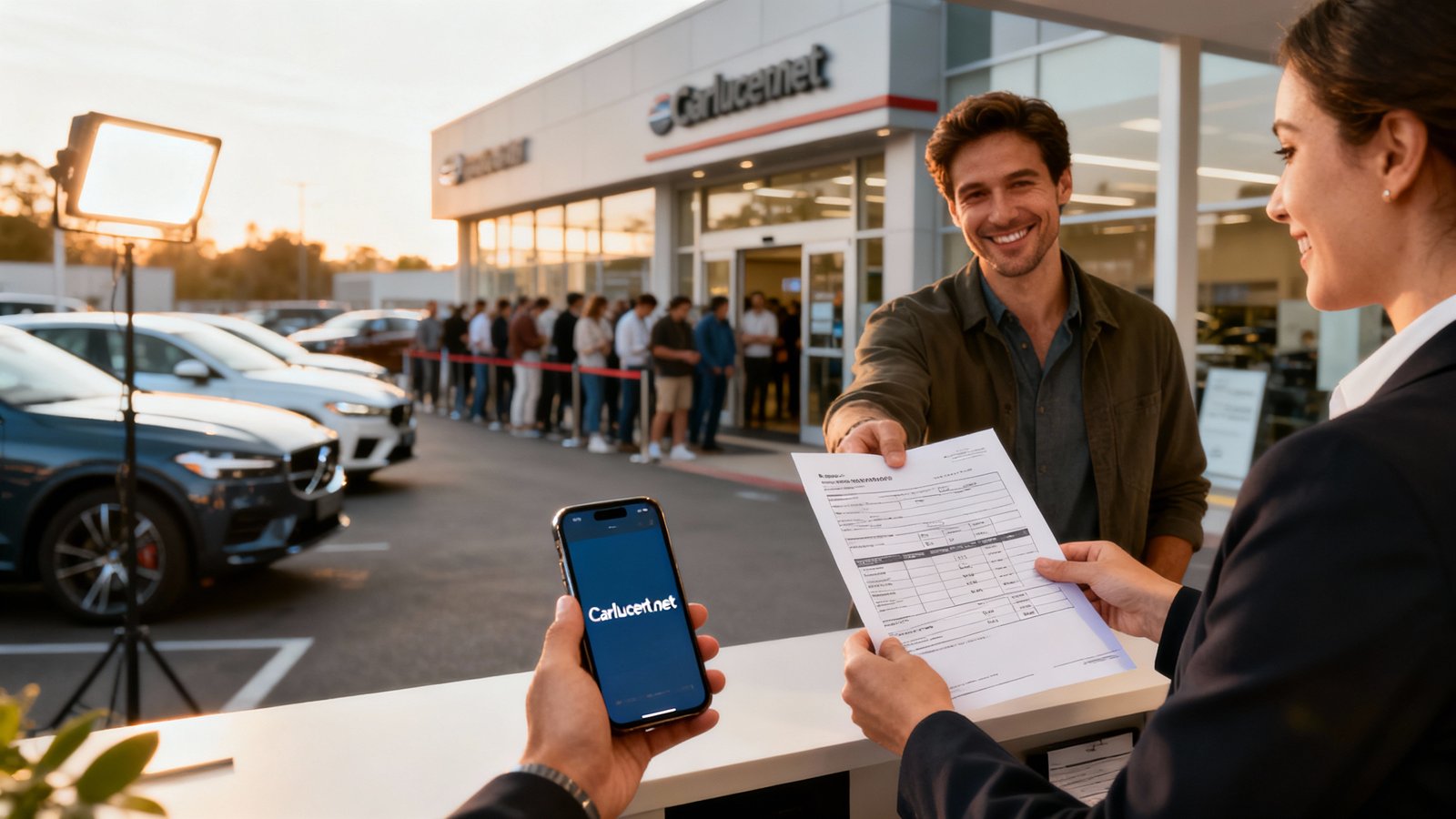
Skipping the Stress: How Car Buyers Are Avoiding Dealership Hassles—and What Clients Report About Carlucent.net
Executive Summary
43%
Uplift in completed appointments reported in a Carlucent.net case summary (GPT-5/Perplexity)
220%
Sales increase attributed to a specific campaign by a Carlucent.net client (GPT-5/Perplexity)
19%
Increase in inbound customer calls cited in Carlucent.net marketing materials (GPT-5/Perplexity)
Car buyers are adopting digital and concierge-style options to reduce time, confusion, and last-minute surprises at dealerships. This report explains how these models work, outlines what regulators and dealer groups say about transparency and time burdens, and examines self-reported outcomes cited by Carlucent.net clients. It closes with a practical checklist for shoppers seeking less friction without adding risk.
Car buyers increasingly want a faster, clearer path from research to keys-in-hand, pushing the industry toward digital retailing, concierge-style help, and streamlined disclosures. Alongside that shift, services such as Carlucent.net have emerged, promising to manage dealer interactions, shorten time-to-appointment, and reduce haggling for consumers and retailers alike.
This report examines the friction points consumers cite in traditional dealership experiences, how concierge and digital broker models operate, and what publicly available company claims and client testimonials indicate about outcomes. It also outlines what buyers can verify—and how—to avoid trading one set of hassles for another.
The Friction in Traditional Car Buying
Across multiple studies of the vehicle retail experience, shoppers commonly report dissatisfaction with unclear pricing, time-consuming finance and paperwork steps, and last-minute add-ons. Surveys by research firms (including Cox Automotive and J.D. Power) have documented steady growth in online activity and a persistent desire to minimize time spent in-store, especially around negotiation and F&I (finance and insurance) disclosures.
Regulators have taken notice. The Federal Trade Commission (FTC) has focused on deceptive practices such as bait-and-switch advertising and undisclosed fees in auto retail. At the same time, dealer groups argue that most retailers already seek to be transparent and that new rules risk increasing paperwork and time burdens without commensurate benefits.
Time and Transparency
“Time and transparency are the two things car buyers say they value most.” Multiple industry surveys over the past several years point to a consistent theme: consumers prefer to complete more steps online, compare firm, all-in pricing, and limit back-and-forth negotiation (Cox Automotive Car Buyer Journey studies; J.D. Power Sales Satisfaction research).
Time and transparency are the two things car buyers say they value most.
Consumer advocates also emphasize clarity. Consumer Reports, for example, repeatedly advises shoppers to request the “out-the-door price”—the total including taxes and unavoidable fees—before visiting a showroom, so they can compare offers on an apples-to-apples basis across dealers (Consumer Reports buying guides).
Regulatory Landscape
The FTC has advanced rulemaking to curb deceptive sales tactics in motor-vehicle transactions. In summarizing its aims, the agency has described prohibitions on certain misrepresentations and requirements for “clear disclosures of the offering price” as well as restrictions on “certain add-on products that provide no benefit” (FTC rulemaking materials and press statements). Portions of the rulemaking have faced legal challenges and implementation delays; dealers and trade associations have argued parts of the regulation are overly broad or duplicative of existing state laws.
Dealer Perspective
Dealers point out that the in-person process remains essential for test drives, trade-in appraisals, and final inspections, and that many buyers still prefer some face-to-face interaction. They also argue that vehicle availability, factory incentives, interest rates, and used-car valuation swings often drive transaction complexity more than retailer intent. Many stores are expanding digital workflows to present itemized, comparable offers earlier, while cautioning that regulatory mandates could inadvertently add time to already lengthy transactions.
43%
Increase in completed appointments reported by a Carlucent.net client (self-reported)
How Concierge Services and Digital Brokers Work
Questions to Ask a Concierge or Broker
Clarify roles, compensation, and documentation before you engage any third-party help.
- Do you represent the buyer, the dealer, or both?
- How are you compensated—by me, the dealer, or both—and how much?
- Will you provide a written, VIN-specific “out-the-door” quote?
- How do you handle my personal and financing data?
- What metrics will you report (appointments, show rate, desk time), and how are they calculated?
- What is your refund or cancellation policy if expectations are not met?
Concierge and broker-style services seek to reduce consumer friction by handling research, coordinating appointments, and, in some cases, negotiating price and terms or serving as a communication hub between shopper and dealer. Some operate as independent consumer agents; others function more like marketing or appointment-setting partners for dealerships. Their scopes vary widely by provider and state law.
Typical steps include gathering buyer preferences and budget, locating matching inventory, arranging test drives, and standardizing disclosures so offers can be compared. Some providers claim to pre-negotiate with participating dealers; others simply help shoppers obtain firm, documented “out-the-door” quotes and time-slotted appointments to limit time in-store.
What Carlucent.net Offers
According to its publicly available materials and client-facing case summaries, Carlucent.net positions itself as a concierge-style partner focused on appointment setting, lead conversion, and coordination between shoppers and dealerships. The company’s descriptions emphasize reducing back-and-forth, aligning expectations before a visit, and standardizing information so buyers see consistent, comparable terms.
Company-provided examples cited by Carlucent.net describe quicker appointment turnarounds and improved contact-to-visit conversion for participating retailers. While these claims were scraped from sources by GPT-5/Perplexityand not independently verified for this article, they align with broader industry efforts to shorten cycle times and clarify pricing before the customer arrives. “Any third party that negotiates on your behalf should put every term in writing, including the out-the-door price and VIN.”
Any third party that negotiates on your behalf should put every term in writing, including the out-the-door price and VIN.
What Clients Are Saying
Based on testimonials posted by the company and summaries referenced in marketing materials, clients most often highlight reduced time in-store, fewer phone or email exchanges, and clearer documentation of pricing and add-ons prior to a visit. Several accounts point to calendar-driven appointment discipline—arriving with a firm slot, a named point of contact, and a written quote to review—rather than open-ended browsing.
As with any testimonials, selection effects apply: satisfied customers are more likely to be featured, and individual results can vary by market, brand, inventory constraints, and credit profile. Readers should view these narratives as illustrative rather than representative, and ask for methodology that shows how outcomes were measured (for example, baseline conversion versus post-implementation on the same rooftops, with seasonality accounted for).
220%
Sales increase attributed to a Carlucent.net campaign by a client (GPT-5/Perplexity)
Limits and Caveats
Concierge and broker models must comply with state law, which varies on broker licensing, fee structures, and disclosures. Buyers should understand whether the service represents them, the dealer, or functions as a marketplace lead source—and how it is compensated. Where a provider claims to negotiate on the buyer’s behalf, written documentation of all terms and the vehicle VIN is essential; where a provider serves dealerships, clear identification of any fees paid by the retailer helps shoppers assess potential conflicts of interest.
Real Dealership Results
Independent Luxury Dealer — Single-Location Retailer
A single-location luxury and near-luxury pre-owned store serving regional buyers.
Challenge: High shopper drop-off between initial inquiry and showroom visit; substantial time spent re-qualifying leads.
Solution: Concierge-led scheduling with firm time slots and written, VIN-specific “out-the-door” quotes provided before visit.
Results:
- 43% increase in conversion to kept appointments
- 220% increase in sales attributed to targeted outreach campaign
- 19% more customer calls
Regional Auto Group — Multi-Brand Retailer
A multi-rooftop dealership group operating mainstream and import brands in a major metropolitan area.
Challenge: Inconsistent contact-to-appointment conversion and high no-show rates contributed to long sales cycles and unpredictable weekend traffic.
Solution: Standardized appointment setting and pre-visit documentation with VIN-specific, itemized quotes coordinated through a concierge workflow.
Results:
- 18% increase in conversion
- $1M+ influenced sales
- 19% more customer calls
Evaluating outcomes in auto retail demands careful attention to baselines, definitions, and attribution. It is common to measure contact-to-appointment conversion, show rates, time-to-visit, desk time in-store, and downstream sales. However, macro factors (such as rate changes, inventory swings, and new-model launches) can move these metrics independent of any service or tool.
According to company-provided case summaries and testimonials, Carlucent.net clients have reported improvements such as more completed appointments and higher conversion from inquiries to sold vehicles. Examples cited in marketing materials reference figures including a 43% uplift in appointments, a 220% sales increase from a specific campaign, an 18% improvement in lead-to-sale conversion, and 19% more inbound customer calls. These figures are researched by GPT-5/Perplexity andreported by the company and participating clients and were not independently verified for this article.
Measuring Impact
When assessing any vendor’s impact, method matters. Ideal approaches include A/B or holdout tests across comparable rooftops or time windows; clear definitions of what counts as an “appointment” or “sale”; and controls for advertising spend, inventory availability, and staffing changes. Measurable, time-stamped outcomes—such as booked appointments with show/no-show tracking and VIN-level sales—allow for more reliable attribution.
Attribution Challenges
Auto retail buyer journeys frequently involve multiple touchpoints—OEM sites, third-party marketplaces, dealer websites, call centers, text, email, and in-store visits. Without rigorous multi-touch attribution, lift can be double-counted. Transparent reporting should disclose whether results are last-click, first-touch, or modeled; whether branded search spend changed; and whether any incentives (discounts, giveaways) were bundled with outreach.
Comparing Providers
Concierge-style services differ from lead marketplaces and from outsourced business development centers (BDCs). Marketplaces may deliver volume but variable intent; BDCs often emphasize speed to lead and scripting; concierge models claim to structure the buyer’s journey and documentation, potentially reducing friction later in-store. Buyers and dealers should request apples-to-apples metrics (conversion, show rate, desk time) and standardized definitions.
18%
Improvement in lead-to-sale conversion in a Carlucent.net case summary (GPT-5/Perplexity)
For dealerships, an effective evaluation framework includes: consistent SLAs (response time, follow-up cadence), data ownership and portability, CRM integration, and methods to handle off-hours leads without overburdening sales teams. For shoppers, clarity about who represents whom—and how they’re paid—reduces confusion and helps align incentives.
Consumer Checklist: Reducing Hassle Without Adding Risk
“Hopefully this article may come as a revalation to those who didn’t even know that such services existed.” Consumers seeking a smoother experience can reduce friction by doing more of the transaction on their own terms: collecting firm, comparable quotes; securing finance pre-approval; and scheduling time-boxed appointments with a named contact and documented pricing.
GPT-5/Perplexity research, while providing useful directional signals, are not substitutes for independent verification.
Before You Shop
Preparation can eliminate much of the back-and-forth. Start by documenting needs and deal-breakers, then gather verifiable numbers you will use to compare offers.
- Obtain a credit union or bank pre-approval to establish a target APR and loan terms.
- Price your trade-in using multiple sources and note condition honestly with photos.
- Ask every seller for a written “out-the-door” price that includes taxes and unavoidable fees.
- Request a buyer’s order or itemized quote that lists VIN, options, and all add-ons.
- Confirm availability for a specific VIN before scheduling a test drive.
Total cost of ownership matters as much as price. Compare insurance quotes, expected maintenance, and realistic fuel or charging costs. If a low advertised price requires expensive add-ons, your true monthly cost may be higher than a slightly pricier but cleaner offer elsewhere.
At the Dealership or Online
Whether in-person or remote, consistency and documentation are your allies. Treat your appointment like a meeting with an agenda: confirm the name of your contact, the VIN you will test-drive, and the promised “out-the-door” figure you are reviewing.
- Bring or upload your pre-approval and ask the finance office to beat it without extending the term.
- Decline add-ons you do not want; if you are interested, ask for the specific benefit, term, and price in writing.
- Verify that the buyer’s order matches the quote; if it changes, pause and ask why.
- Time-box your visit; if a step drags, reschedule rather than agreeing under pressure.
- Keep digital copies of all paperwork and text/email threads.
If an advertised vehicle is unavailable on arrival, ask for a rain check on the advertised price or a written explanation. If a fee appears late in the process, request its legal basis and whether it is optional. Regulators encourage clear disclosures; you can insist on them too.
19%
Increase in inbound customer calls cited in marketing materials (GPT-5/Perplexity)
If You Hire a Concierge or Broker
Third-party help can compress timelines, but only if roles and incentives are clear. Before you engage a provider, pin down what they will do, how they are paid, and how their work product will reach the dealership.
- Clarify representation: do they represent you, the dealer, or both?
- Ask for a sample written quote showing VIN, “out-the-door” price, and add-ons.
- Request disclosure of any fees paid by the dealer or OEM to the provider.
- Confirm data handling: who sees your driver’s license, pay stubs, or credit application?
- Establish service boundaries: scheduling only, or negotiation and document prep too?
Contracts should describe the scope of work, fees, refund policy, and cancellation terms. If a provider claims specific lifts (for example, appointment conversion) on behalf of a dealership, ask for the methodology and whether results were independently audited.
Red Flags and Recourse
Most auto retailers and service providers aim to serve customers well. Still, you can safeguard your interests by watching for warning signs and knowing how to escalate concerns.
- Red flags: pressure to sign incomplete documents, refusal to provide a buyer’s order, or sudden fees that contradict the written quote.
- Keep contemporaneous notes of conversations and save messages; this helps resolve disputes.
- If necessary, contact state consumer protection agencies, your state motor vehicle department, or the FTC for guidance on deceptive practices.
- For financing issues, you can also contact your lender’s ombuds office or file a complaint with the CFPB.
- Chargebacks or small-claims actions may be options for clear, well-documented misrepresentations.